Coffee Processing Methods Explained: Washed, Natural, Honey, Anaerobic & More
A practical guide to how coffee cherries become green coffee—and what processing terms actually mean
mokhaLab · October 5, 2026 · 20 min read ·
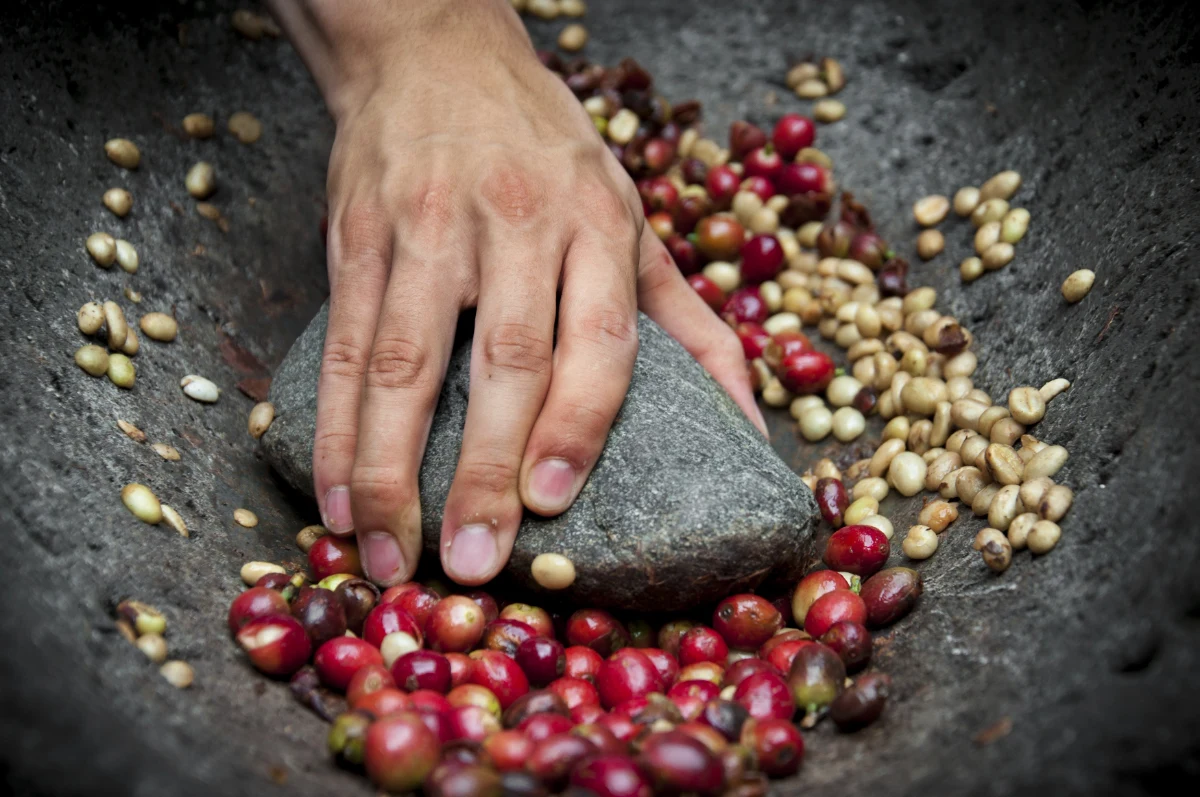
When you buy specialty coffee, the bag may say washed, natural, honey, anaerobic, carbonic maceration, yeast fermented, or a combination of several of these terms.
But what do they actually mean?
Coffee processing begins after the coffee cherries are harvested. Producers must separate the coffee seeds from the fruit, manage fermentation, and dry the coffee to a stable moisture level before it becomes green coffee ready for roasting.
The important thing to understand is that coffee-processing terms do not all describe the same thing. “Washed,” “natural,” and “honey” primarily describe how the cherry and mucilage are handled. Terms such as “anaerobic,” “yeast fermentation,” and “carbonic maceration” describe fermentation conditions or interventions that can be combined with other processing approaches.
And while processing can strongly influence a coffee's character, no processing method guarantees a particular flavor. Variety, ripeness, climate, altitude, fermentation, drying, storage, roasting, and brewing all contribute to the final cup.
Coffee Processing at a Glance
Process / TechniqueCherry removed before drying?Mucilage during drying?Controlled fermentation?Defining characteristicWashedYesLittle or noneOftenMucilage is removed before dryingNaturalNoYesUsually naturally occurringWhole cherry dries around the seedHoneyYesYesUsually naturally occurringSome mucilage remains during dryingWet-HulledYesLittle or noneOftenParchment is removed before full dryingAnaerobicDependsDependsYesLow-oxygen fermentation environmentCarbonic MacerationUsually no initiallyYesYesWhole cherries ferment in a CO₂-rich environmentYeast FermentationDependsDependsYesSelected yeast is intentionally introducedDouble AnaerobicDependsDependsYes, twiceTwo anaerobic fermentation stagesThermal ShockDependsDependsNot necessarilyControlled temperature change within processing
Important: These categories can overlap. A coffee can, for example, be described as an anaerobic natural or a yeast-fermented washed coffee.
From Coffee Cherry to Green Coffee
Before looking at individual methods, it helps to understand the basic structure of a coffee cherry.
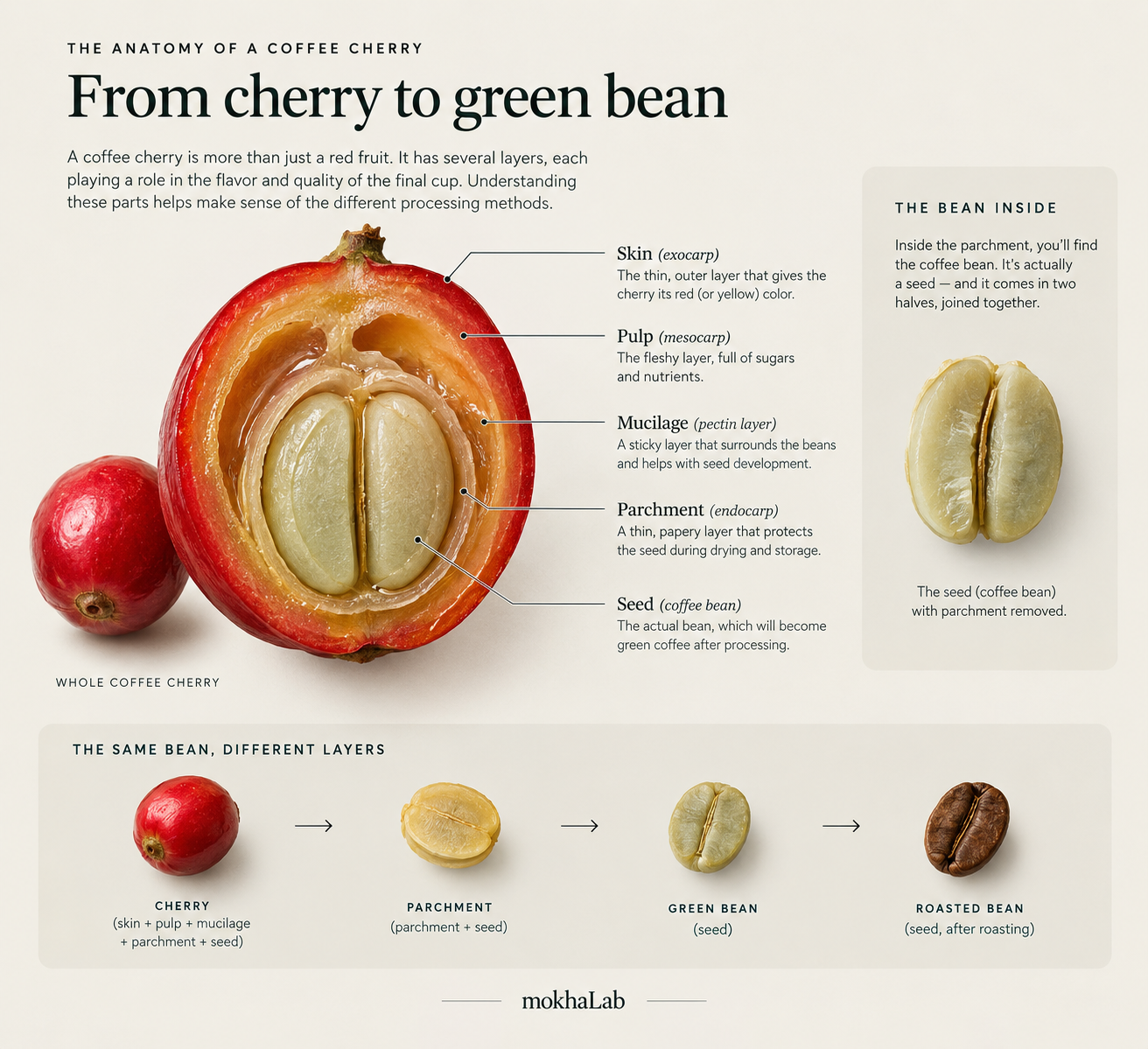
A coffee cherry generally contains:
Skin → Pulp → Mucilage → Parchment → Seed
The seed is what eventually becomes the roasted coffee bean.
After harvesting, producers must decide how to remove or manage the fruit surrounding the seed, how fermentation will occur, and how the coffee will be dried.
A simplified processing pathway looks like this:
Harvest → Sorting → Cherry processing → Fermentation → Drying → Dry milling → Green coffee
Not every coffee follows exactly this sequence. Some steps are combined, repeated, skipped, or performed in a different order.
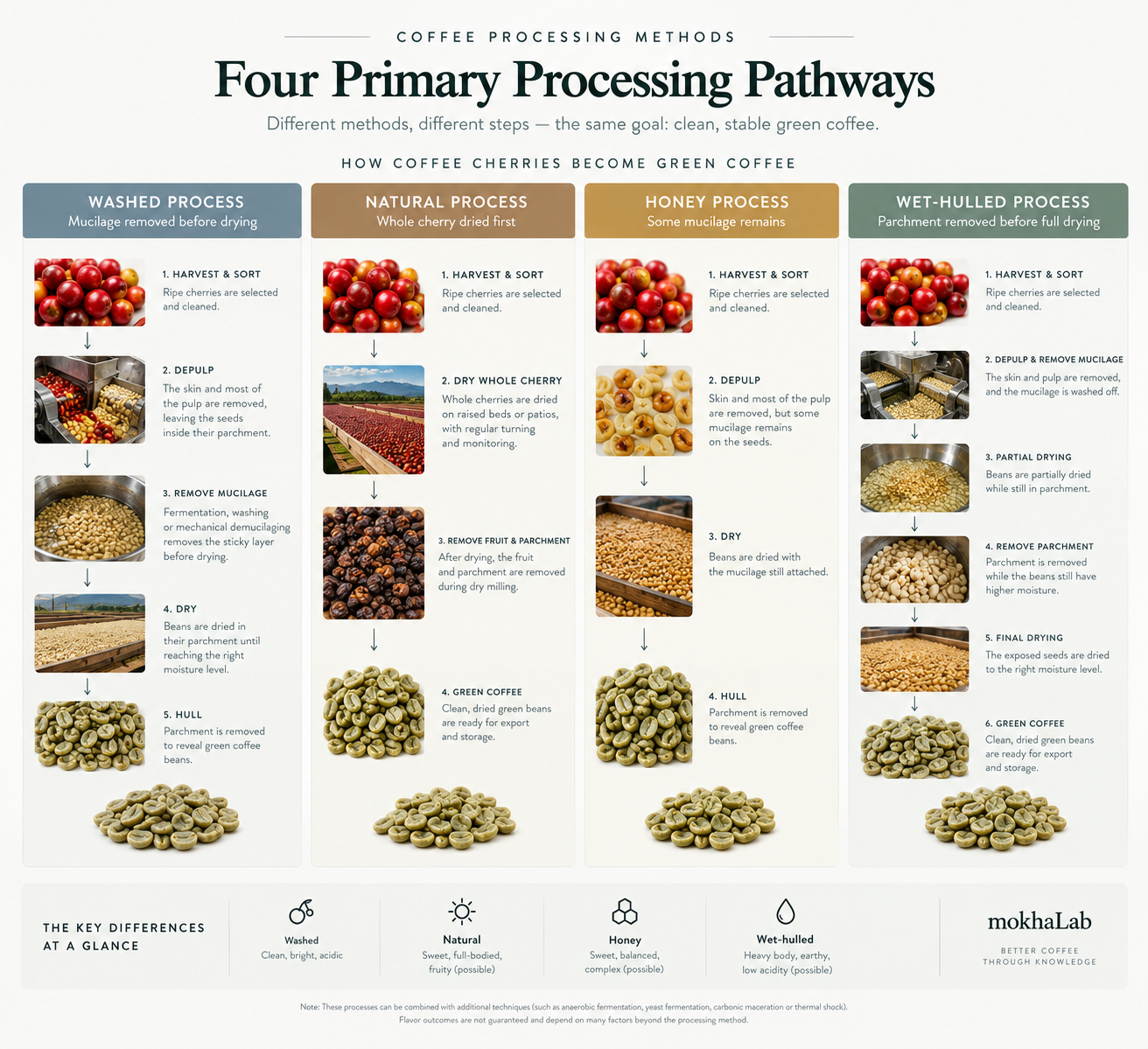
1. Washed Process
Mucilage is removed before drying
In the washed process, ripe coffee cherries are sorted and mechanically depulped, removing the skin and most of the pulp while leaving the seeds inside their parchment.
The remaining mucilage is then removed before drying. Depending on the producer and mill, this can involve fermentation, mechanical demucilaging, washing, or a combination of methods.
The coffee is subsequently dried in its parchment until it reaches a stable moisture level suitable for storage.
What does “washed” actually mean?
“Washed” does not necessarily mean that coffee beans are simply soaked in water.
The defining feature is that the mucilage is removed before the coffee is dried.
Traditional washed processing may use water during fermentation and washing, while some modern mills remove mucilage mechanically or use other low-water approaches.
How can it affect the cup?
Washed coffees are often associated with clearly expressed acidity and distinct variety or origin characteristics. However, these characteristics are not guaranteed.
Cherry ripeness, variety, fermentation conditions, drying, climate, roasting, and brewing can all influence the final cup.
Key idea
Cherry → Depulp → Remove mucilage → Dry in parchment → Hull
Flavour Profile
Washed coffees are often associated with a clean, clearly defined cup, where acidity, sweetness, and the characteristics of the coffee variety can be easier to distinguish.
Common flavour impressions include:
- Acidity: Bright, crisp, citrus-like, or apple-like
- Sweetness: Cane sugar, honey, or delicate sweetness
- Body: Light to medium, with a clean finish
- Aromatics: Floral, citrus, stone fruit, or subtle herbal notes
2. Natural (Dry) Process
The whole coffee cherry is dried around the seed
In the natural process, whole coffee cherries are dried before the fruit is removed.
After harvesting, producers typically sort the cherries and spread them on raised beds, patios, or other drying surfaces. The cherries are regularly turned and monitored to promote even drying.
During this period, the fruit surrounding the seed naturally undergoes microbial and biochemical changes.
Once the cherries have dried sufficiently, the dried fruit and parchment are removed during dry milling.
Why is drying so important?
Natural processing requires careful management of:
- Cherry ripeness
- Drying speed
- Airflow
- Humidity
- Temperature
- Turning frequency
- Weather conditions
Uneven drying can increase the risk of spoilage, mold, or undesirable fermentation.
How can it affect the cup?
Natural coffees may show greater perceived sweetness, fuller body, or more pronounced fruit character than some washed coffees.
However, these are possible characteristics, not guarantees.
The final result depends on much more than the fact that the coffee was naturally processed.
Key idea
Whole cherry → Dry → Remove dried fruit and parchment → Green coffee
Flavour Profile
Natural coffees are often associated with pronounced fruit character, perceived sweetness, and a fuller mouthfeel. Because the whole cherry remains around the seed during drying, the process can influence the coffee's aroma and flavour development.
Common flavour impressions include:
- Acidity: From soft and rounded to bright and juicy
- Sweetness: Ripe fruit, berries, or tropical fruit
- Body: Medium to full, sometimes with a syrupy texture
- Aromatics: Strawberry, blueberry, cherry, dried fruit, or other ripe-fruit notes
3. Honey Process
Some mucilage remains during drying
Despite the name, no honey is added to honey-processed coffee.
The term refers to the sticky mucilage surrounding the seed.
In honey processing, the coffee cherry is depulped, removing the skin and most of the pulp, but some mucilage remains attached to the parchment-covered seed during drying.
The coffee is then carefully dried while the remaining mucilage is still present.
Why are there different types of honey?
Producers and coffee-growing regions may use terms such as:
- White honey
- Yellow honey
- Red honey
- Black honey
These terms can describe differences in how much mucilage remains and how the coffee is dried.
However, these color categories are not universal scientific standards. Their meaning can vary between producers and regions.
For this reason, a detailed description of the actual processing method is more useful than relying on the color label alone.
How can it affect the cup?
Honey coffees may show a combination of characteristics associated with washed and natural processing, such as sweetness, body, and fruit character.
But again, processing does not determine flavor by itself.
Key idea
Cherry → Depulp → Some mucilage remains → Dry → Hull
Flavour Profile
Honey-processed coffees often sit somewhere between the flavour tendencies associated with washed and natural coffees. They can combine clear acidity with noticeable sweetness, a rounded body, and varying degrees of fruit character.
Common flavour impressions include:
- Acidity: Balanced, bright, or gently rounded
- Sweetness: Honey, caramel, brown sugar, or ripe fruit
- Body: Medium to full, often with a smooth mouthfeel
- Aromatics: Stone fruit, citrus, red berries, or caramel-like notes
4. Wet-Hulled Process
Parchment is removed before the coffee is fully dry
Wet-hulling, also known as Giling Basah, is particularly associated with Indonesia.
The coffee is initially depulped and the mucilage is removed. The seeds are then partially dried while still protected by parchment.
Unlike conventional washed processing, the parchment is removed before the coffee reaches its final drying stage.
The exposed coffee seeds are then dried further until they reach a suitable moisture level.
Why is this unusual?
Removing parchment while the coffee still has relatively high moisture content exposes the seed to greater mechanical handling while it is still soft.
This makes careful control of:
- Moisture
- Cleanliness
- Drying
- Handling
- Storage
especially important.
How can it affect the cup?
Wet-hulled coffees are sometimes associated with heavier body, lower perceived acidity, and earthy or herbal characteristics.
However, these characteristics are not inherent guarantees of wet-hulling.
A clean, well-controlled coffee should not be confused with one showing earthy or musty characteristics caused by poor drying or storage.
Key idea
Cherry → Depulp → Mucilage removed → Partial drying → Hull → Final drying
Flavour Profile
Wet-hulled coffees are often associated with a heavier body, softer perceived acidity, and earthy or herbal flavour characteristics. These tendencies are particularly familiar in coffees from Indonesia, where the method is widely used.
Common flavour impressions include:
- Acidity: Often relatively low or rounded
- Sweetness: Brown sugar, dark chocolate, or subtle molasses
- Body: Full, heavy, or creamy
- Aromatics: Herbs, cedar, spices, dark chocolate, or earthy notes
5. Anaerobic Fermentation
Fermentation in a low-oxygen environment
“Anaerobic” refers to a fermentation environment with limited oxygen.
It does not describe one single recipe.
Depending on the producer, whole cherries or depulped coffee may be placed into sealed or controlled vessels. Fermentation conditions can then be monitored using variables such as:
- Temperature
- Time
- pH
- Oxygen availability
- Pressure
- Microbial activity
After fermentation, the coffee continues through a chosen drying process.
Is anaerobic coffee always washed?
No.
An anaerobic fermentation can be combined with different processing pathways.
For example:
Anaerobic natural
Whole cherries → Anaerobic fermentation → Dry whole cherries
or:
Anaerobic washed
Depulped coffee → Anaerobic fermentation → Mucilage removal → Dry
How can it affect the cup?
Some anaerobically fermented coffees display pronounced fruit, floral, or fermentation-related aromas.
However, the term anaerobic does not guarantee a specific flavor profile.
Fermentation duration, temperature, microbial population, cherry condition, processing method, drying, roasting, and brewing all matter.
Poorly controlled fermentation can also produce undesirable flavors.
Key idea
Anaerobic = fermentation condition, not one fixed processing recipe
Flavour Profile
Anaerobic fermentation can produce a wide range of flavour profiles because the outcome depends on the coffee used, the fermentation conditions, and the processing method that follows.
Some coffees develop expressive fruit character and complex aromas, while others retain a more traditional profile.
Common flavour impressions can include:
- Acidity: From crisp and vibrant to softer and more rounded
- Sweetness: Ripe fruit, tropical fruit, or concentrated sweetness
- Body: Variable, ranging from light and silky to rich and syrupy
- Aromatics: Floral notes, berries, tropical fruit, spices, or distinctive fermentation-related aromas
6. Carbonic Maceration
Whole cherries ferment in a carbon-dioxide-rich environment
Carbonic maceration is a controlled fermentation technique inspired by methods used in other areas of food and beverage production.
Whole coffee cherries are typically placed into a sealed vessel where the environment becomes rich in carbon dioxide and low in oxygen.
The intact cherries undergo fermentation before being processed and dried.
How is it different from anaerobic fermentation?
The terms are sometimes used interchangeably in coffee marketing, but they can describe different protocols.
A key distinction is that carbonic maceration typically emphasizes:
Whole cherries + controlled CO₂-rich environment
By contrast, an anaerobic fermentation may involve whole cherries or depulped coffee and does not necessarily follow a carbonic-maceration protocol.
How can it affect the cup?
Depending on the protocol, carbonic maceration may produce distinctive aromatic, fruit, or fermentation-related characteristics.
But the process name alone does not determine the final flavor.
Safety consideration
Carbon dioxide can accumulate in enclosed spaces and can become hazardous at high concentrations. Commercial processing environments using sealed tanks or injected gases require appropriate ventilation, monitoring, and safety procedures.
Key idea
Whole cherries → Controlled CO₂-rich fermentation → Processing → Drying
Flavour Profile
Carbonic maceration can produce distinctive aromatic characteristics, particularly when whole cherries undergo controlled fermentation in a carbon-dioxide-rich environment.
Depending on the protocol, the resulting coffee may have expressive fruit aromas and a flavour profile that differs noticeably from more conventional processing methods.
Possible flavour impressions include:
- Acidity: Bright, juicy, or fruit-like
- Sweetness: Ripe fruit, sweet berries, or candy-like impressions
- Body: Variable, from delicate and silky to rounded
- Aromatics: Floral notes, red berries, tropical fruit, or distinctive fermentation-related aromas
7. Yeast Fermentation
Selected yeast is intentionally introduced
Coffee cherries naturally carry microorganisms, including yeasts.
In controlled yeast fermentation, however, producers intentionally introduce a selected yeast strain into the coffee.
The yeast may be applied to:
- Whole cherries
- Depulped coffee
- Coffee with mucilage present
The producer can then monitor variables such as yeast strain, temperature, fermentation time, and coffee-to-liquid ratio.
Why use selected yeast?
The goal may be to make fermentation more controlled and repeatable or to encourage particular biochemical changes.
However, adding yeast does not automatically make a coffee higher quality.
The strain, dose, temperature, fermentation endpoint, cherry condition, drying, and subsequent processing all matter.
Can yeast fermentation be combined with other processes?
Yes.
A coffee can be described as:
Yeast-fermented natural
or:
Yeast-fermented washed
In these cases, yeast fermentation is an intervention within a broader processing pathway rather than a replacement for that pathway.
How can it affect the cup?
Depending on the yeast and processing conditions, coffee may develop different fruit, floral, spice, or caramel-like aromatic characteristics.
These outcomes are not universal.
Key idea
Selected yeast + controlled fermentation + chosen drying/processing method
Flavour Profile
Selected yeast fermentation gives producers an additional way to influence how coffee develops during processing. Different yeast strains can behave differently, so the resulting flavour profile depends on the strain and the conditions in which it is used.
Depending on the process, possible flavour impressions include:
- Acidity: Bright, balanced, or fruit-like
- Sweetness: Perceived sweetness resembling ripe fruit, caramel, or honey
- Body: Variable, from light and smooth to rounded
- Aromatics: Floral notes, berries, stone fruit, or spice-like characteristics
8. Double Anaerobic Fermentation
Two successive low-oxygen fermentation stages
Double anaerobic fermentation generally refers to a process involving two separate anaerobic fermentation stages.
A common version may follow this sequence:
Whole cherries → First anaerobic fermentation → Depulping → Second anaerobic fermentation → Drying
The exact recipe varies between producers.
The important distinction is that there are two fermentation stages, rather than simply one extended fermentation.
Why use two stages?
The producer may be attempting to influence the coffee's biochemical development at different points in processing.
Because the process involves multiple controlled stages, consistency requires careful monitoring of:
- Temperature
- Time
- pH
- Oxygen availability
- Cherry condition
- Drying
How can it affect the cup?
Some coffees processed this way may show intense fruit or fermentation-related characteristics.
However, there is no single flavor profile associated with every double anaerobic coffee.
Key idea
Two controlled anaerobic fermentation stages—not simply one longer fermentation
Flavour Profile
Double anaerobic fermentation involves two separate low-oxygen fermentation stages, giving producers additional opportunities to influence the coffee's biochemical development.
Some coffees processed this way show pronounced fruit character or distinctive fermentation-related aromas. Others remain relatively balanced and restrained.
Possible flavour impressions include:
- Acidity: Juicy, vibrant, or rounded
- Sweetness: Ripe berries, tropical fruit, or concentrated sweetness
- Body: Medium to full, sometimes with a syrupy mouthfeel
- Aromatics: Complex fruit notes, florals, spices, or fermentation-related aromas
9. Thermal Shock Processing
A controlled temperature change during processing
Thermal shock is a processing technique in which coffee is exposed to a controlled temperature change as part of a larger processing protocol.
The exact temperatures, duration, sequence, and purpose can vary considerably between producers.
The coffee may be heated and then rapidly cooled, or exposed to other controlled temperature transitions depending on the protocol.
Is thermal shock a fermentation method?
Not by itself.
Thermal shock describes a temperature-treatment step. It may be used before, during, or after other processing or fermentation stages.
For example, a producer may combine thermal treatment with a controlled fermentation.
What does thermal shock do?
Some producers use temperature changes with the goal of influencing the extraction of compounds, fermentation behavior, or aromatic development.
However, the independent effect of thermal shock is not yet as well established as some traditional processing principles, and commercial protocols vary.
The term should therefore be treated as a description of a processing intervention rather than a guaranteed flavor category.
Key idea
Controlled temperature change → May accompany fermentation or another processing method
Flavour Profile
Unlike washed, natural, or honey processing, thermal shock does not have a well-established, universal flavour profile of its own.
Producers may use controlled temperature changes as part of a broader processing protocol to influence fermentation or aromatic development. The resulting flavours depend on the other steps involved.
Depending on the coffee and the complete process, possible flavour impressions may include:
- Acidity: Variable, depending on the coffee and processing protocol
- Sweetness: Variable, with no dependable sweetness profile associated with thermal shock alone
- Body: Variable, depending on the coffee and its processing
- Aromatics: Potentially distinctive fruit, floral, or other aromatic characteristics when supported by the broader process
Processing Methods Can Be Combined
One of the most important things to understand about modern coffee processing is that these terms are not mutually exclusive.
A coffee can have multiple processing descriptors.
For example:
Natural
Whole cherry → Dry
Anaerobic Natural
Whole cherry → Anaerobic fermentation → Dry
Yeast Natural
Whole cherry → Selected yeast fermentation → Dry
Anaerobic Washed
Depulp → Anaerobic fermentation → Mucilage removal → Dry
Double Anaerobic Natural
Whole cherry → Anaerobic fermentation → Depulp → Second anaerobic fermentation → Dry
This is why a coffee label may contain several processing terms.
What Actually Determines Flavor?
Processing is important, but it is only one part of the equation.
A simplified way to think about the final cup is:
Genetics + Environment + Ripeness + Processing + Drying + Storage + Roasting + Brewing → Cup
Variety
Different coffee varieties have different genetic characteristics that can influence flavor, structure, acidity, and sweetness.
Growing environment
Altitude, temperature, rainfall, soil, shade, and other environmental factors affect cherry development.
Ripeness
The maturity of the cherries at harvest can strongly influence the quality and consistency of the final coffee.
Processing
How the cherry, mucilage, and seed are handled—and how fermentation is controlled—can alter the chemical composition of the coffee.
Drying
Drying speed, temperature, humidity, airflow, and uniformity can significantly affect quality and shelf stability.
Storage
Green coffee continues to change after processing. Moisture, temperature, oxygen, light, packaging, and storage duration can influence how the coffee ages.
Roasting
The roast transforms the green coffee and has a major influence on acidity, sweetness, body, aroma, and bitterness.
Brewing
Even excellent green coffee can produce a poor cup if it is improperly ground, dosed, extracted, or brewed.
Processing is therefore best understood as one part of a much larger chain.
Common Coffee Processing Misconceptions
“Washed coffee is always soaked in water.”
Not necessarily.
The defining characteristic of washed processing is that mucilage is removed before drying. Water may be used, but the exact method varies.
“Honey coffee contains honey.”
No.
The name refers to the sticky mucilage surrounding the coffee seed. No honey is required.
“Natural coffee means there is no fermentation.”
Incorrect.
Fermentation can naturally occur while whole coffee cherries are drying.
“Anaerobic means there is absolutely no oxygen.”
Not necessarily.
In coffee processing, “anaerobic” generally refers to a low-oxygen or oxygen-limited fermentation environment. Exact conditions vary.
“Anaerobic is a completely separate process from natural and washed.”
Not exactly.
Anaerobic describes a fermentation condition and can be incorporated into different processing pathways.
“Natural coffee always tastes fruity.”
No.
Natural processing can be associated with fruitier or sweeter characteristics, but variety, ripeness, drying, roasting, and brewing all influence the final cup.
“A darker honey means better coffee.”
Not necessarily.
Color terminology such as white, yellow, red, and black honey is not a universal quality ranking.
“A strong fermentation flavor means the coffee was processed better.”
Not necessarily.
A pronounced fermentation character can be intentional, but excessive or uncontrolled fermentation can also produce undesirable flavors.
How to Read Processing Information on a Coffee Bag
Coffee labels often combine multiple terms.
For example:
“Colombia · Caturra · Anaerobic Natural”
This may indicate:
Whole cherries → Controlled anaerobic fermentation → Natural drying
The word “anaerobic” describes the fermentation environment, while “natural” describes the broader physical processing and drying approach.
“Yeast-Fermented Washed”
This may indicate:
Depulped coffee → Selected yeast fermentation → Mucilage removal → Drying
Here, “yeast-fermented” describes the microbial intervention, while “washed” describes how the mucilage is handled before drying.
“Double Anaerobic Honey”
This could indicate a coffee that undergoes two anaerobic fermentation stages while retaining some mucilage during the drying stage.
The exact recipe still depends on the producer.
When possible, look for the producer's processing notes rather than relying only on the name.
Coffee Processing Glossary
Coffee Cherry
The fruit of the coffee plant containing the seeds that eventually become coffee beans.
Pulp
The fleshy material surrounding the coffee seed beneath the cherry skin.
Mucilage
A sticky, pectin-rich layer surrounding the parchment-covered seed.
Parchment
The protective layer surrounding the coffee seed after the outer fruit has been removed.
Depulping
The mechanical removal of the coffee cherry's skin and pulp.
Fermentation
A series of microbial and biochemical processes that can occur while coffee is being processed. Producers may allow fermentation to occur naturally or control it through specific conditions or microbial interventions.
Anaerobic Fermentation
Fermentation conducted in a low-oxygen or oxygen-limited environment.
Drying
The controlled removal of moisture from processed coffee until it reaches a stable level suitable for storage.
Dry Milling
The post-drying process used to remove parchment and prepare coffee for grading and export.
Wet-Hulling
Removing parchment before the coffee has completed its final drying stage.
Green Coffee
Processed coffee seeds that have been dried and prepared for storage, export, and roasting.
So, Which Processing Method Is Best?
There is no universally “best” processing method.
A well-executed washed coffee can be exceptional. So can a natural, honey, wet-hulled, anaerobic, or yeast-fermented coffee.
The more useful question is:
Which processing method was appropriate for the coffee, environment, producer, and desired result—and how well was it executed?
Processing should therefore be viewed as a tool rather than a quality ranking.
A carefully controlled process can produce excellent coffee, while the same process performed poorly can produce defects.
The Bottom Line
Coffee processing is the transformation that takes a harvested coffee cherry and turns it into stable green coffee ready for roasting.
The major traditional pathways—washed, natural, honey, and wet-hulled—primarily differ in how the fruit, mucilage, parchment, and seed are handled.
Modern processing techniques such as anaerobic fermentation, carbonic maceration, selected yeast fermentation, double anaerobic fermentation, and thermal shock introduce additional ways to control or modify the process.
The most important thing to remember is that a processing name is a description, not a flavor guarantee.
The final cup is shaped by the interaction of genetics, growing conditions, cherry maturity, processing, fermentation, drying, storage, roasting, and brewing.
Understanding processing therefore isn't about memorizing which method “tastes fruity” or “tastes clean.”
It is about understanding what happened to the coffee between harvest and green bean—and how those decisions can influence the coffee you eventually taste.
Sources & Further Reading
For a deeper understanding of coffee processing, fermentation, drying, and coffee quality, readers should consult technical and scientific resources from organizations and researchers specializing in coffee science, including the Specialty Coffee Association, World Coffee Research, the International Coffee Organization, and peer-reviewed research on coffee processing and fermentation.
Processing terminology can vary between producers, regions, and commercial coffee labels. Where terminology is not standardized, this guide focuses on the defining characteristics of the process rather than assuming one universal recipe.